
<< Back to Articles Index page
The West End
This page contains a brief overview of the "West End" of Chudleigh. Click on
this icon to download the full PDF report:

By "West End", we refer to the roughly triangular land with apex at the junction of Fore Street and Oldway, down the Parade to Coberg Corner, over to Oldway and back.
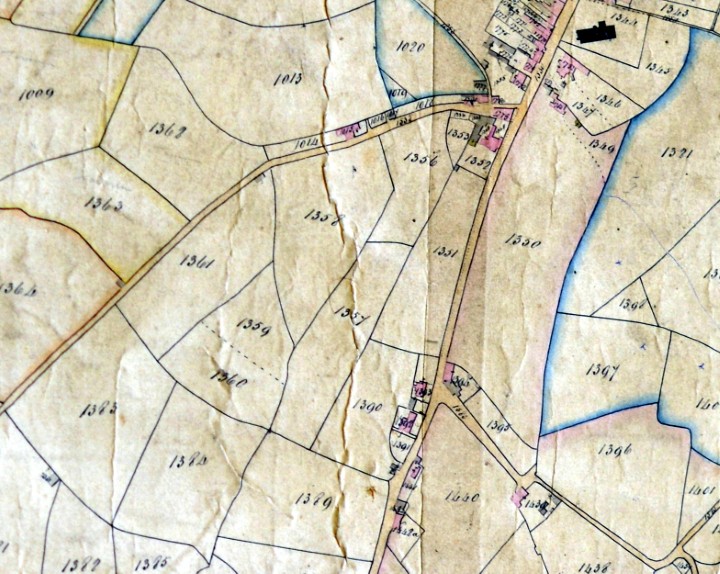
1838 Tithe map showing the West End of Chudleigh
Charter for Fairs & Markets
After the Norman conquest, the bishops of Exter controlled everything in Chudleigh, including the right to collect dues and taxes on fairs and markets. In his official capacity of 'Treasurer of the Realm' Bishop Stapledon applied to King Edward II in 1309 for the granting of Chudleigh's Charter which included holding markets and fairs on stipulated dates. At a considerable fee the Charter was granted for the next 200 years and four elected members of the Parish Governing Board were appointed to undertake the management of subsequent markets and fairs. After the Dissolution in 1536, King Henry VIII again sanctioned the Chudleigh Charter, updating it from 1309.
An indenture dated May 1597 between Thomas Bridges and Henry Clifford, including twenty-two others on behalf of the parish, obtained for a fee of £150 the markets, fairs, market halls and playing grounds, plus the plot of ground being Old Way, between Chudleigh town and Broomsland Gate on the south part which has always been used for the said fairs. This indenture stresses again that all tolls and dues from the markets and fairs contribute to the Chudleigh charities.
Upper Oldway
At the head of our West End triangle stands the early 19th century property Old Fairfield House. Originally named Fairfield, It was re-named Old Fairfield during the 1890s following the building of Fairfield, a well-proportioned brick-built house on the opposite side of Parade. During the early 19th century Old Fairfield House was a town house of considerable size, enclosed in its own walled garden. The stone wall between Old Fairfiled and the moderm bungalow 'Desian' was originally the boundary wall of the ancient Chudleigh town. On the forecourt of Old Fairfield House stood its coach house with its entry on to Parade. This is now a separate house accessed from Oldway.
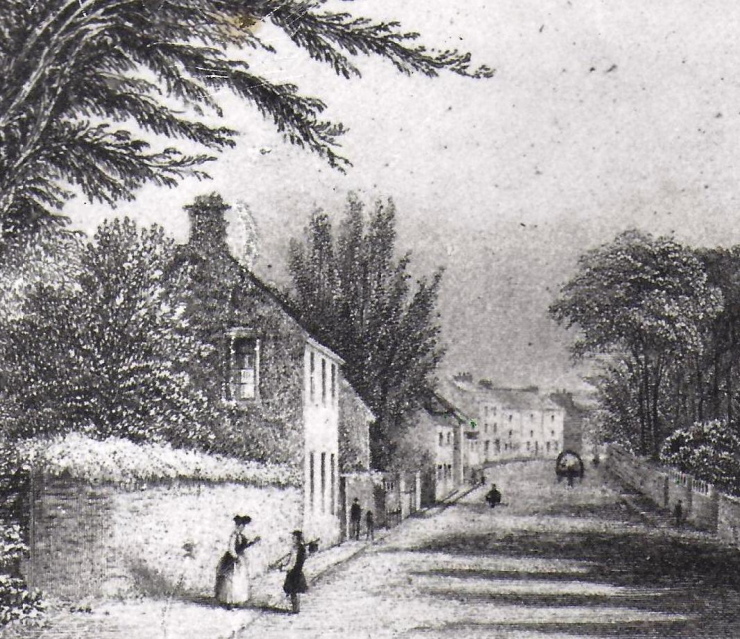
Old Fairfield House (left) in 1838
On the opposite side of the road at the juncture of Parade and Oldway stood Brockley House with five terraced cottages leading down Oldway. The cottages were demolished in 1938 to allow road widening. Brockley House was demolished in 1970 to allow further widening.
Animal Pound
At the extreme southern end of our triangle, at the head of Station Hill, stood the parish animal pound. Recorded by the Board of Parish Affairs from before the mid-17th century, it was part of the ancient Trendle Bere area. Situated at the southern perimeter of the fairs' fields it played a vital role in the fair’s functions. The pound was an enclosure where stray animals from the fairs and parish highways were kept, only released when owners paid a toll to the pound keeper. The site is today remembered by Pound Cottage.
Oldway Alms Houses
This area of land was set aside in the Charter for the accommodation of the poor and needy. In 1552 parish registers of the poor were introduced and in 1553 justices of the peace were empowered to raise compulsory funds for the relief of the poor. Although space in the Chudleigh Church House had been allocated for use by the paupers, new legislation and the passing of the 'Elizabethan Poor Law‘ in 1601 made it apparent this space was not sufficient. Money was raised and new alms houses were built in 1611. Mary Jones in her title History of Chudleigh published in 1852 (and later republished in 1875) describes the buildings as consisting of two storeys of five rooms, each with an exterior wooden gallery leading to the upper apartments. These were located in Pottery Lane, now Oldway, near the junction with Fore Street.
Pottery Meadow and the Gas Works
In 1856 Mr Whiteway, the miller at Town Mills of Clifford Street, sold part of Pottery Meadow to the newly-formed Chudleigh Gas Company for a sum of £85 and construction commenced during the 1860s. A local newspaper article of April 1869 stated the town was to be lit partly on the twenty-first of that month. The introduction of gas lighting throughout the town continued and on the 6th September, 1870 the town hall was lit for the first time by gas. In December 1875 the gas company extended the mains to Coburg and erected public gas lamps along Parade. In 1930, Chudleigh's street lighting was converted to electricity, but the gas works continued operating until the 1960s. The works area is now Skaigh Engineering; the remains of the gas holder can still be seen in the compound.
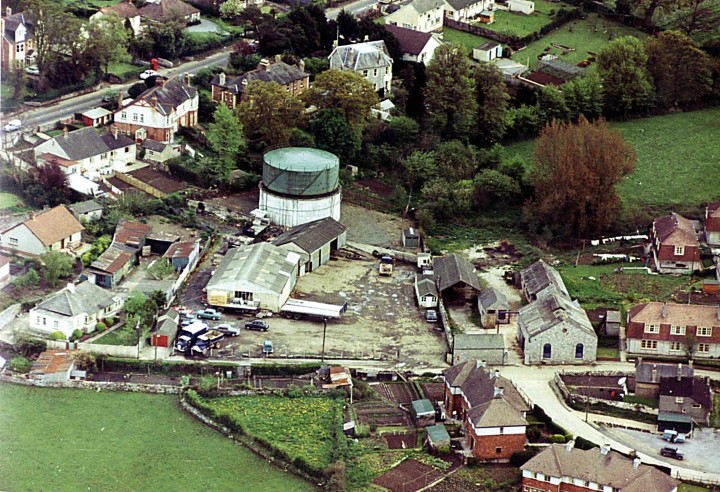
1967 aerial view of the gas works off Oldway.